You can judge hay by its smell and colour, but you cannot see what is actually in it (protein, sugar, energy, minerals and vitamins). That is what the forage analysis is for: a laboratory test of the exact nutritional value of your hay, haylage or grass.
Why is it useful?
- Optimising your horse’s diet and preventing deficiencies or excesses: supplementing based on facts instead of assumptions
- Preventing health problems, for example avoiding too much sugar in a horse with laminitis or EMS (see grass and sugars)
- Cost savings by targeted supplementation, instead of adding everything “just to be safe”
- Personal advice tailored to your horse, its workload and any conditions it may have
What exactly is measured?
The analysis looks at analytical components (dry matter, crude protein, crude fibre and sugar), minerals and trace elements (calcium, phosphorus, magnesium, zinc, copper) and energy values. Some analyses also give an indication of the fructan level, which is relevant for sugar-sensitive horses. A result looks roughly like this:
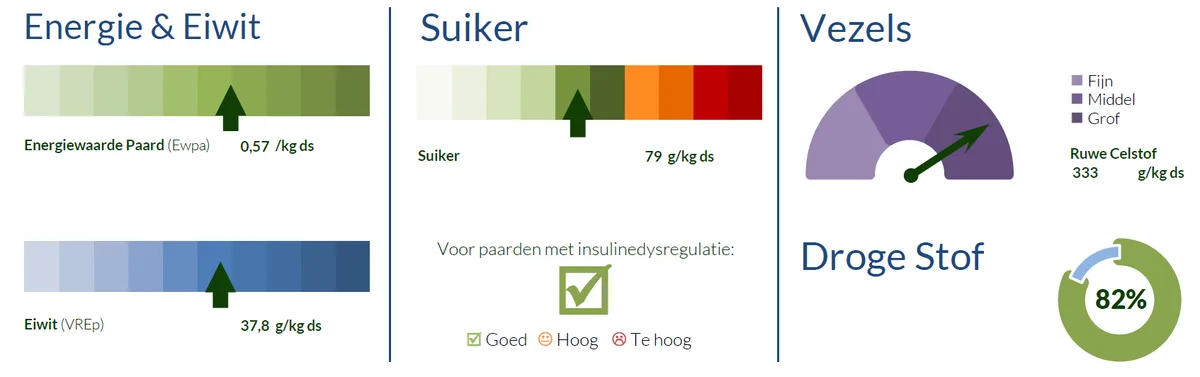
In this example, the sugar content (79 g/kg DM) falls within the safe margin for a horse with insulin dysregulation, while the picture for another batch of hay could be completely different. That precise difference is why an analysis tells you more than a smell and colour test.
How does it work in practice?
- Sampling: take a handful of hay from several bales and mix it together (a single handful says little)
- Shipping: you buy a forage analysis online and then send the sample to the analysis bureau
- Laboratory analysis: the laboratory carries out the analysis using validated methods
- Results and advice: you receive a detailed report with the results and sometimes concrete feeding advice
Allow one to ten days between sending the sample and receiving the results.
And then: how you feed matters just as much
With the results in hand, you can feed more precisely. But the amount of sugar and energy in the hay is only half the story: how you offer that hay determines how quickly your horse eats it. A horse that eats a low-sugar batch of hay in ten minutes still gets a spike, instead of the gradual intake its digestion needs. See feeding hay: which method suits your stable for an overview of feeding methods, and why a slow feeder matters for the full background on that last point.